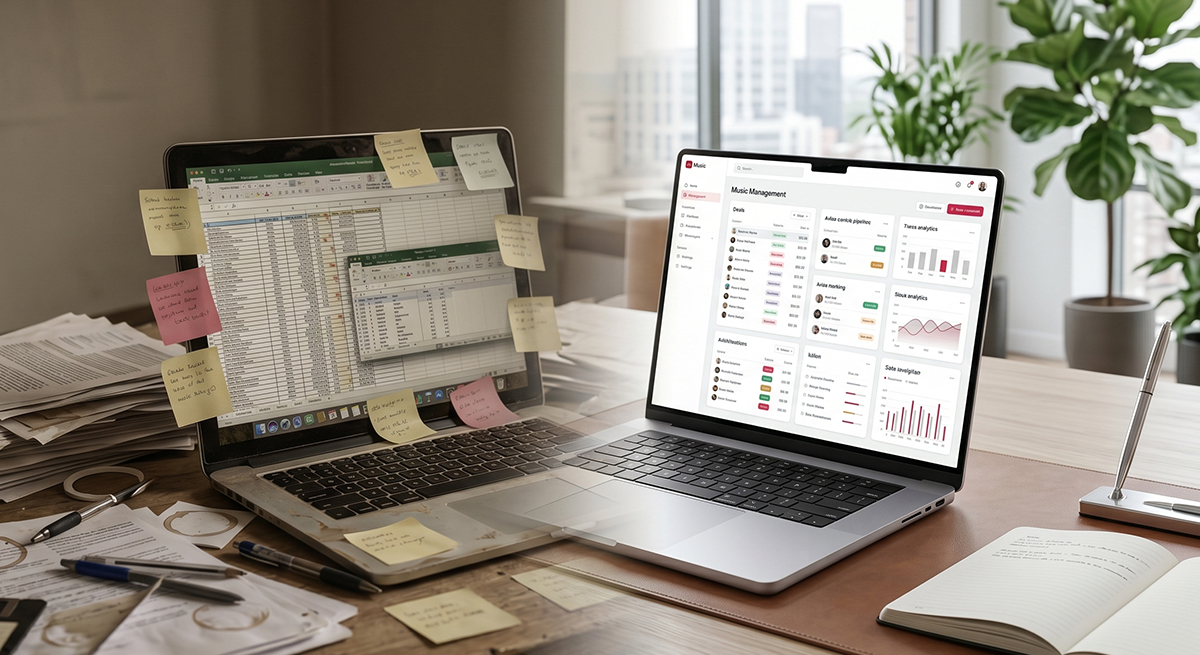
Key Takeaways:
- Traditional spreadsheets and email chains burden music agencies with manual, error-prone processes.
- Maintaining separate calendars, budgets, and contact lists “is becoming increasingly untenable” in a fast-moving industry.
- Music management software centralizes tasks (booking, contracts, finances, communication) into one platform, eliminating scattered files and reducing double-bookings or missed updates.
- Booking agents and tour managers gain streamlined workflows: they can confirm dates instantly, auto-calculate commissions, and track every contract and payment in real time.
- These tools free agencies’ teams from repetitive admin, letting them focus on relationships in the music industry and strategy. Agencies report 30–40% time savings on admin tasks, boosting productivity and artist development.
- Robust analytics and reporting are built-in. Unified data lets agencies analyze past events’ success, plan tours, and optimize pricing, something static spreadsheets simply cannot do efficiently.
- Independent artists and small labels also benefit: even solo performers can use templates and calendars in music-specific platforms to avoid missing releases or shows.
Introduction
Many music agencies and promoters still rely on Excel or Google Sheets and endless email threads to manage tours, bookings, and artist data. In today’s fast-paced music industry, this patchwork approach quickly shows its limits. Agencies juggling multiple spreadsheets for schedules, contracts, and finances often find themselves spending hours on manual updates and troubleshooting errors. Simple version control issues (multiple file copies) and missing updates can cost money and damage relationships in the music industry. One industry article notes that agencies using only emails and spreadsheets “have group text threads and breakout meetings to confirm redundant information” – an inefficient system ripe for mistakes.
Fortunately, dedicated music management platforms now exist to replace that chaos. These specialized tools act as a “single source of truth,” centralizing an agency’s entire workflow – from booking calendars to contract templates to payment tracking. By integrating all data into one web or cloud-based system, agencies gain transparency and automation. As we’ll see, this shift frees booking agents and tour managers from tedious admin, letting them focus on creative and strategic tasks – like building artist careers and strengthening industry partnerships.
Spreadsheet vs Music Software: Key Differences
| Feature / Metric | Spreadsheets & Email (Legacy) | Music Management Software (Modern) |
| Data Centralization | Multiple disconnected files (per tour, artist) | Single integrated database (all events in one place) |
| Updates & Changes | Manual updates across sheets; high error risk | Automated data updates; cascading changes (move one date, related tasks auto-adjust) |
| Collaboration | Hard to track version history; siloed edits | Real-time collaboration with user permissions and activity logs |
| Contracts & Docs | Create contracts from scratch (copy-paste terms); high copy error risk | Auto-generate contracts from templates using stored deal details |
| Communication Logging | Emails and chat scattered; no centralized log | All interactions logged per event; preserved even if staff change |
| Financial Tracking | Expenses and payments tracked in separate sheets | Linked financial module (invoices, expenses, commissions tied to events) |
| Analytics & Reporting | Limited (pivot tables at best); manual effort | Built-in dashboards: revenue per event, audience data, profitability, etc |
| Scalability | Breaks down as data grows | Designed to scale with agencies (handles hundreds of events seamlessly) |
| Setup & Cost | Minimal software cost; high manual labor over time | Subscription or license cost; saves labor and reduces costly errors |
| Typical Time Savings | 0%–20% (workflow remains manual) | Agencies report ~30–40% less admin time after switching |
The Limitations of Spreadsheets for Music Agencies
Spreadsheets and manual systems can work for a small operation, but they quickly break down under the complexity of a growing agency. Agents and tour managers handling dozens of artists often end up with separate files for each tour date, expense report, and contact list. One music-industry guide observes that many local venues and agencies “still tend to use methods they have relied on for decades” – a hodgepodge of spreadsheets for calendars, finances, contacts, and logistics. However, this approach is “becoming increasingly untenable”.
Even meticulous organizers are vulnerable: manual data entry errors are common, and it’s easy to overlook a crucial update. If a tour date shifts or an artist’s contract changes, every relevant spreadsheet must be manually updated. As a result, agencies see costly mistakes like double-bookings or miscalculated payments. (One industry case noted that a single missed confirmation “costs the artist a show,” and an incorrect commission calc “costs you trust” with the artist.)
Spreadsheets also lack collaboration features. A shared Excel file may get emailed around, but it’s hard to track who edited what or when. This lack of visibility makes it difficult for multiple team members to coordinate. A HubSpot analysis of spreadsheets in business points out that when many hands edit one file, errors multiply and it’s nearly impossible to pinpoint the source of mistakes. Without a controlled system, managers can’t easily audit changes or ensure data security.
Finally, traditional spreadsheet workflows severely limit an agency’s ability to scale. A small agency might limp by on Google Sheets or shared documents, but as the roster grows, spreadsheets become a bottleneck. Large spreadsheets are slow, error-prone, and offer no real-time dashboard or reporting features. One guide warns: “As your data grows, spreadsheets become error-prone,” and manual fixes burn countless hours. By contrast, a dedicated tool is built to scale: it will automatically update related tasks, handle more users, and integrate data across the organization.
Manual, Error-Prone Processes
Manual tracking means manual mistakes. Data like booking holds, advance payments, or tour budgets kept in spreadsheets are static until updated by hand. If one agent forgets to log a deposit or update a date, everyone else is working off outdated info. Spreadsheets “have to be updated row by row” whenever plans change. In practice, this slows teams and leads to version-control headaches. Multiple coordinators may each have their own copy of a file, then spend time reconciling differences.
Industry analysts note that spreadsheets lack real-time visibility and often “contain some type of error” as data volume grows. For example, manually tracking artist commissions or show expenses in a worksheet is tedious and prone to formula mistakes. In fact, when processing 50+ settlements, “manual commission calculations in a spreadsheet guarantee errors,” according to one expert. Those errors translate directly into financial losses or disputes. In short, every hand-off between spreadsheets and emails is another opportunity for a hiccup.
Poor Collaboration and Visibility
Because spreadsheets don’t automatically track who did what, teams lose transparency. A lead agent might wonder: which dates are confirmed? Which offers are still pending? Without a shared platform, that requires calls or messages that clutter communication channels. Even basic questions like “Who last updated this file?” become hard to answer.
One music agency blog points out that “reliable information in real-time” is the key benefit of a unified system. Without it, agencies rely on ad hoc meetings or group chats to reconcile multiple spreadsheets – which wastes time and creates friction. A unified music management tool, by contrast, lets everyone see the same up-to-date schedules and contact notes.
Lack of Real-Time Data and Insights
Spreadsheets also provide poor analytics. For instance, if you want to analyze average revenue per event or identify which artist is most profitable, a pivot table might not suffice without significant manual effort. As one source notes, spreadsheets treat “customer data as static” – it just sits there until someone combs through it. Agencies using spreadsheets typically lack a clear way to report on performance across all shows or tours.
In contrast, music management software can automatically generate reports on ticket sales, expenses, and other key metrics. With all data in one place, agencies can gain insights at the touch of a button. As we will see, these built-in analytics are a major advantage of modern systems.
How Music Management Software Changes the Game
Music management software (sometimes called event or booking management software) is built specifically for the live music industry’s needs. Think of it as project management + CRM + financial tracking, all in one tool. It replaces “a patchwork of spreadsheets, docs, emails, and group chats” by providing a single digital workspace for every event and artist campaign.
Key capabilities include:
- Centralized Calendar & Booking Pipeline: Every event or tour is created as a project in the system. A Booking Agent can enter an offer from a promoter, and the software checks artists’ calendars instantly. It tracks status through each stage (hold, contract sent, deposit received, etc.). For example, one report notes agencies can confirm date availability “in seconds” rather than via multiple texts and calls. A unified calendar across all agents prevents double-bookings and lets anyone see a holistic schedule at a glance.
- Automatic Document Generation: Instead of copy-pasting details into Word contracts, the software auto-populates templates from the booking record. Generating a contract for a new show becomes a two-minute task. Email templates for deposit requests or reminders can also be sent from the platform. This eliminates the copy-paste errors common in manual workflows and ensures consistent branding and terms.
- Financial Tracking & Commissions: Agencies earn commissions on bookings and track show expenses. Good software links finances directly to events. If a deposit comes in, it is logged under that show. Commission rates (per artist or deal type) are stored in the system; when a settlement is processed, the software calculates each party’s share automatically. This saves hours of spreadsheet math and avoids disputes. Budgets, actuals, and profits can be viewed per tour or period without juggling Excel formulas.
- Artist & Contact Management: Every artist, manager, and venue contact lives in the system. Agents update notes and attach documents (press kits, tech riders) to each profile. When communications happen (calls, emails), logs can be entered or automatically synced, creating a searchable history. A record of “who said what and when” follows each show, so if personnel change, nothing is lost. This centralized CRM-like feature strengthens relationships: artists and managers appreciate timely follow-ups and fewer slips.
- Collaboration Tools: Modern platforms have built-in chat, notifications, and shared task lists. Teams assign responsibilities (e.g. “Bob handles PR, Alice confirms stage plot”) within the system. Everyone gets alerts for upcoming deadlines. Comments on tasks keep discussions contextual. This replaces long email threads and reduces meeting overload. With mobile apps or web access, a tour manager on the road can instantly update schedules or view venue details without a laptop or clunky emails.
- Data Analytics & Reporting: By pulling all data into one place, agencies can run powerful reports. A key benefit noted by industry experts is comprehensive analytics on decisions like which artists to book or how to price tickets. The software can generate charts of monthly revenue, audience counts, or profitability by event. Some platforms even integrate with ticketing and social media metrics, giving a real-time dashboard on each event’s success. This level of insight is unattainable with basic spreadsheets and helps agencies plan strategically.
Music management software turns a fragmented, manual workflow into a streamlined digital operation. It automates tedious tasks and ensures no data is siloed. This technological “backbone” lets agencies work faster and smarter, even as they handle more artists and shows.
Who Benefits: Agents, Managers, and Artists
Modern music management platforms serve everyone in the ecosystem. While large agencies gain the most obvious returns, smaller teams and even solo artists can see big wins too.
- Booking Agencies and Agents: For these core users, the advantages are clear. A booking agency can manage an entire artist roster from one dashboard. Agents can see all current offers, pending shows, and past performances at a glance. They can respond to promoters instantly (availability checks and new hold requests are in the same system). Automated features (like contract generation and commission calculation) handle routine tasks, reducing errors as agencies scale. The result is faster, more reliable operations: deals get processed quicker, and artists trust that no dates slip through the cracks.
- Tour Managers and Production Teams: Specialized tools greatly ease the tour workflow. A tour manager can use the software to schedule every tour date, book travel, and coordinate crew assignments without flipping between emails and spreadsheets. If they oversee multiple shows, a shared calendar ensures no overlaps or conflicts. All tour-related logistics – from gear lists to loading schedules – can be logged per event. When changes occur (say a show is canceled or moved), the updated timeline is instantaneously visible to promoters and venue partners as well. This means less confusion on the road and fewer emergency fixes.
- Independent Artists and Small Labels: Even solo musicians or indie labels benefit. Instead of ad-hoc methods, artists can use these tools to organize their releases and gigs. For example, an independent artist can create a “Single Release” project in the system: set the release date, and the software auto-generates marketing and distribution tasks backwards from that date. This removes guesswork about deadlines. Similarly, even a one-person booking operation can use a platform like a mini-CRM to track which contacts to follow up with. The key is that artists aren’t dependent on manual memory. As one guide puts it, solo artists use management software to offload their brain’s memory, reducing missed deadlines and “version confusion”.
- Managers and Labels: Artist managers juggling multiple acts gain a centralized view of all clients. They no longer need separate files per artist; everything integrates. Labels with rosters can standardize release and promotion workflows, increasing efficiency across their teams.
- Enhancing Industry Relationships: Perhaps most importantly, all users see better relationships in the music industry. When everyone – agents, managers, tour staff, and artists – accesses the same up-to-date system, it fosters trust and clarity. Promoters get timely answers; venues have accurate advance info; artists know someone is tracking their best interests. The time agents used to spend fixing spreadsheet errors can now go into personal interactions: checking in with artists, scouting new talent, or coordinating with publicists.
For example, one agency manager noted the difference: formerly, team members wasted time “re-keying information across channels,” but with software “we always know who is doing what, and everyone is aligned,” allowing them to nurture client relationships instead. In essence, the automation of routine work builds stronger networks – a crucial edge in an industry built on connections.
Implementing a Better System
Making the switch to music management software is increasingly common. Many agencies report that deploying a single platform quickly reveals its value. In initial deployment, teams often convert their existing spreadsheets into the system, gradually adjusting their processes. Modern solutions usually offer templates for common workflows (like gig bookings, tour routing, or royalty tracking), which speeds adoption.
Though adopting new software requires some training, it pays off swiftly. Agencies often see improved booking response times and fewer administrative mistakes. Over time, consistent data entry builds a valuable knowledge base. One long-term benefit is scalability: an agency in its first years might track ten artists manually, but as it grows to dozens or hundreds, the software can scale with little extra effort.
Your team doesn’t have to start completely from scratch. Many platforms can import existing spreadsheets or email contacts. Once imported, the software begins organizing data automatically. Many agencies begin by using free or trial versions of tools, then upgrade to full-featured systems as their needs grow. The consensus is: a free tool in use beats a paid tool unused.
Overall, the industry trend is clear: music management platforms are moving from novelty to necessity. As spreadsheets have shown their limits, agencies that embrace these digital systems find they save countless hours and avoid costly errors. The investment in better software tends to pay off many times over, in efficiency gains and in peace of mind.
Conclusion
In an era where the music business demands agility, relying on spreadsheets alone is a liability. Music management software offers agencies a way to streamline operations, reduce errors, and focus on artist development instead of paperwork. By centralizing scheduling, communication, and finance, these tools turn chaotic email chains into smooth workflows. In practice, agencies that switch report significantly faster turnarounds on bookings and more time for creative work.
For example, one long-time partner at an entertainment agency said they “couldn’t imagine [their] lives without” such software, after adopting a platform that keeps all offers, itineraries, and payments “under one roof”. Even independent artists or managers working on tight budgets find that free or low-cost music-specific tools offload tedious tasks and prevent missed deadlines.
Ultimately, the goal is simple: replace manual hassles with digital efficiency, so agencies, agents, and tour managers can nurture the artistic side of their jobs. Platforms like YourTempo exemplify this new approach by offering integrated booking and management tools tailored to the music industry. By consolidating data and automating routine processes, YourTempo (and similar systems) help music professionals work smarter — keeping them one step ahead in a fast-moving live music market.
FAQs
Q: Why are spreadsheets considered outdated for booking agencies?
A: Spreadsheets become cumbersome as agencies grow. They require manual updates across multiple files and offer no easy real-time collaboration. Many agencies find these methods “untenable” because they waste time and introduce errors. Specialized software automates these tasks, keeping all data in one place for better accuracy and teamwork.
Q: How does music management software improve booking and touring?
A: These platforms provide a unified booking pipeline and calendar. An offer made to an artist is logged in the system, which checks the tour calendar, generates contracts, and tracks payments automatically. This means booking agents and tour managers can confirm dates in seconds and avoid double-bookings. The software also centralizes travel and logistics, so changes cascade through the schedule without manual recalculation.
Q: Can smaller agencies or independent artists benefit from these tools?
A: Absolutely. Even solo artists or boutique agencies use music-specific software to organize releases and gigs. For example, an independent artist can set up a project with a release date, and the tool builds all required tasks (pressing CDs, scheduling posts, booking shows) around it. For small agencies, the system acts like a mini-CRM, tracking contacts, deals, and tasks without a big IT investment. It brings enterprise-level organization to any size.
Q: What features should a music agency look for in new software?
A: Key features include centralized calendars, contact management, contract generation, and finance tracking. Look for tools that automate dependencies (e.g. shift all related dates if a show moves) and support team collaboration (comments, notifications, shared calendars). Integration with ticketing or accounting systems can also be a plus. A good platform will have analytics dashboards so you can track revenue, attendance, and artist performance over time.
Q: How do booking agents and tour managers save time using these systems?
A: Booking agents save time because they no longer toggle between spreadsheets and email – everything is in one app. The software can auto-calculate commissions, alert agents about deadlines, and generate contracts with a click. Tour managers save time by not re-entering itinerary updates; if a flight changes, the new schedule updates in all reports. In practice, many agencies report 30–40% time savings on administrative tasks when using specialized software.
Q: Do these platforms help with finances and reports?
A: Yes. Music management software often includes financial modules for budgets, invoices, and settlements. Instead of juggling expense spreadsheets, agencies log costs and payments in-app. The system can generate financial reports (like profit per show or total expenses) instantly. This unified data also feeds into performance reports so you can see what’s working (e.g., which tours generated profit) and plan future strategy accordingly.
Q: What about security and data sharing?
A: Proper music management systems are cloud-based and require secure logins, so access is controlled. Unlike emailed spreadsheets (which can be forwarded easily), sensitive data like contact lists and contracts remain within the platform. Permissions can limit who sees what. For example, a booking agent might see full contract details, while venue contacts only see show schedules. This ensures confidentiality and that all team members have the right information for their role.