August 12, 2026 |
Tour Pro
Key Takeaways
- A complete music tour budget covers three distinct phases: pre-tour planning, on-road tracking, and post-tour reconciliation. Most artists only think about the first one.
- Transportation typically represents the single largest cost category on any tour budget — and its total depends almost entirely on how efficiently the tour is routed.
- Revenue from merch, VIP packages, and fan-funded campaigns can mean the difference between a tour that breaks even and one that generates meaningful profit — but only if it's planned for, not hoped for.
- Every tour budget should include a 10–15% emergency buffer and a tax reserve of at least 25–30% of net tour income to cover self-employment tax obligations.
- Booking agents, tour managers, and artist management firms that track tour financials across multiple artists simultaneously need centralized tools — not individual spreadsheets — to manage that complexity accurately.
Most tours don't fail on stage. They fail in the spreadsheet — or rather, in the absence of one. An artist books ten shows based on what the guarantees look like on paper, ignores the math on everything in between, and comes home two weeks later having lost money they didn't know they were spending.
A complete tour budget template is not a formality. It is the document that tells you, before you confirm a single date, whether the tour makes financial sense — and exactly what needs to change if it doesn't.
What Makes a Tour Budget Template Different from a Guess
A tour budget template is a structured, line-item document that captures every anticipated expense, projects every revenue source, and identifies the exact number of tickets or merch items you need to sell in order to break even — before you leave home.
The word "template" matters here. A generic notes app estimate and a purpose-built music tour budgeting template are not the same thing. The template forces you to account for categories you would otherwise forget: the venue's merch cut, self-employment tax on your guaranteed income, the kill fee provision in your contracts, the cash flow gap between when expenses hit and when final settlements arrive.
Understanding the structure of live performance deals is part of this picture too. If you haven't yet mapped out how guarantees, door splits, and co-promotion arrangements affect your bottom line, our breakdown of how booking agents structure deals and what their commission covers is worth reading before you finalize your budget assumptions.
Phase 1 — Pre-Tour: Fixed and Variable Costs
Before you project a dollar of revenue, you need a complete picture of what the tour costs to run.
Transportation: Your Largest and Most Controllable Cost
The vehicle is where most touring budgets either succeed or bleed out. A cargo van rental in 2025–2026 runs $80–$150 per day for a standard vehicle or $150–$250 for a Sprinter. At fourteen days on the road, van rental alone can hit $2,100 before you factor in fuel.
Fuel math is non-negotiable: estimate total route miles, divide by your vehicle's MPG under load (typically 12–15 for a loaded cargo van), and multiply by the current price per gallon. A 2,500-mile regional tour in a fully loaded van at 13 MPG and $3.60/gallon costs approximately $692 in fuel. That number changes dramatically depending on how efficiently you've routed. Two days of backtracking can add $150–$300 in unrecoverable fuel costs.
Lodging, Food, and Per Diems
Lodging is your second-largest variable. Budget motels and shared Airbnbs run $60–$120 per room per night. A ten-night tour for a four-piece band in two shared rooms runs $600–$1,200 at the low end. Fan-hosted nights eliminate this line entirely — even three hosted nights on a ten-night run saves $180–$360.
Food runs $25–$45 per person per day for meals. At four people across fourteen days, that's $1,400–$2,520 in the budget. Buying groceries on day one and building a cooler culture cuts this by 40–60 percent. Accepting hospitality riders and meal buyouts in your contracts cuts it further.
Crew, Commissions, and Production
Tour managers run $150–$300 per day. FOH engineers cost $100–$250 per day. A merch manager is $75–$150 per day plus a small commission on sales. Most developing-level touring acts do not bring a full crew — band members absorb these roles until the budget supports dedicated positions.
Booking agent commissions run 10–15% of gross performance fees. Manager commissions are 15–20% of all tour income, including merch in some agreements. These come out before you see profit and need to be factored into every revenue projection you build.
Phase 2 — Revenue Projections: What You'll Actually Earn
Optimism is not a revenue strategy. Music tour budgeting requires projecting from conservative assumptions, not from the best-case scenario.
Guarantees, Door Deals, and Split Structures
Flat guarantees at the 50–150 capacity club level currently run $100–$350 for most developing artists. At 150–300 capacity, that range climbs to $350–$800. Budget to the base guarantee, not to what you hope to negotiate.
Door deals give you 70–85% of gross ticket revenue after venue deductions. The risk is real: a bad weather night, a competing show, or a market where you have no history can produce a $60 payout on a show you budgeted at $400. Where possible, push for a split deal — a small guarantee floor plus a percentage above venue break-even. It protects your minimum while leaving upside available.
Never enter a door-only deal in a market where you have no established draw.
Merch Revenue Math
Merch is where most touring budgets move from break-even to profitable. Conversion rates at club-level shows range from 5–15% of the audience. At $30 average transaction and 150 attendees, a 10% conversion rate produces $450 in gross merch revenue. After your cost of goods (typically 30–40% for printed shirts) and the venue's merch cut (standard 10–20% of gross), your net on that show is roughly $200–$270.
Budget merch conservatively: plan for a 7% conversion rate at $28 per transaction as your baseline. Build from there.
Revenue Sources Most Artists Don't Plan For
VIP or soundcheck experiences priced at $40–$75 per person carry almost no additional cost and can add $300–$600 per show to high-margin revenue. An email to your list two weeks out with a fifteen-ticket cap is all it takes. Most artists skip this — which is money left on the table at every date.
Fan-funded tour campaigns, merchandise pre-orders, and selling ticket bundles directly before routing announcements are all legitimate ways to reduce the financial exposure of a tour before day one. None of these require label backing or management infrastructure. They require advance planning.
Your Break-Even Calculation
This is the most important number in your entire budget.
Step one: divide your total tour expenses by the number of shows to get cost per show. Step two: subtract your guaranteed income per show from the cost per show to find your revenue gap per show. Step three: divide the revenue gap by your ticket price to find the number of tickets needed from door sales to break even.
If your ten-show tour costs $9,000 and your average guarantee is $300, your guarantees cover $3,000. The remaining $6,000 must come from merch and door revenue — $600 per show. At $15 per ticket and a 70% artist share on door sales, you need 57 paid tickets per show above your guarantee threshold to break even. Is that realistic in every market on your route?
Know this number before you book. Adjust the route, the show count, or the ticket price until the math makes sense on paper.
The Tour Budget Template: Line by Line
Your expense budget should account for every category in sequence. On the transportation side, that means van or vehicle rental calculated at your daily rate times the number of days on the road, fuel estimated from your total route miles divided by the vehicle's MPG and multiplied by the current price per gallon, tolls and parking as a line item with a realistic estimate based on your routing, and travel insurance as a fixed cost.
For lodging, budget your hotel or Airbnb cost at your nightly rate times the number of paid nights, and mark fan-hosted nights at zero dollars while noting them in your calendar. For food, calculate your per-person per-day food allowance times your headcount times your tour length, and include a separate line for a shared grocery budget.
Crew costs should list each role separately: tour manager at their daily rate times tour length, FOH engineer at their per-show rate times show count, and any merch manager at their daily rate plus a commission percentage. Production costs include gear rental or backline charges per show, equipment insurance for the duration of the tour, and an allowance for cables and consumables.
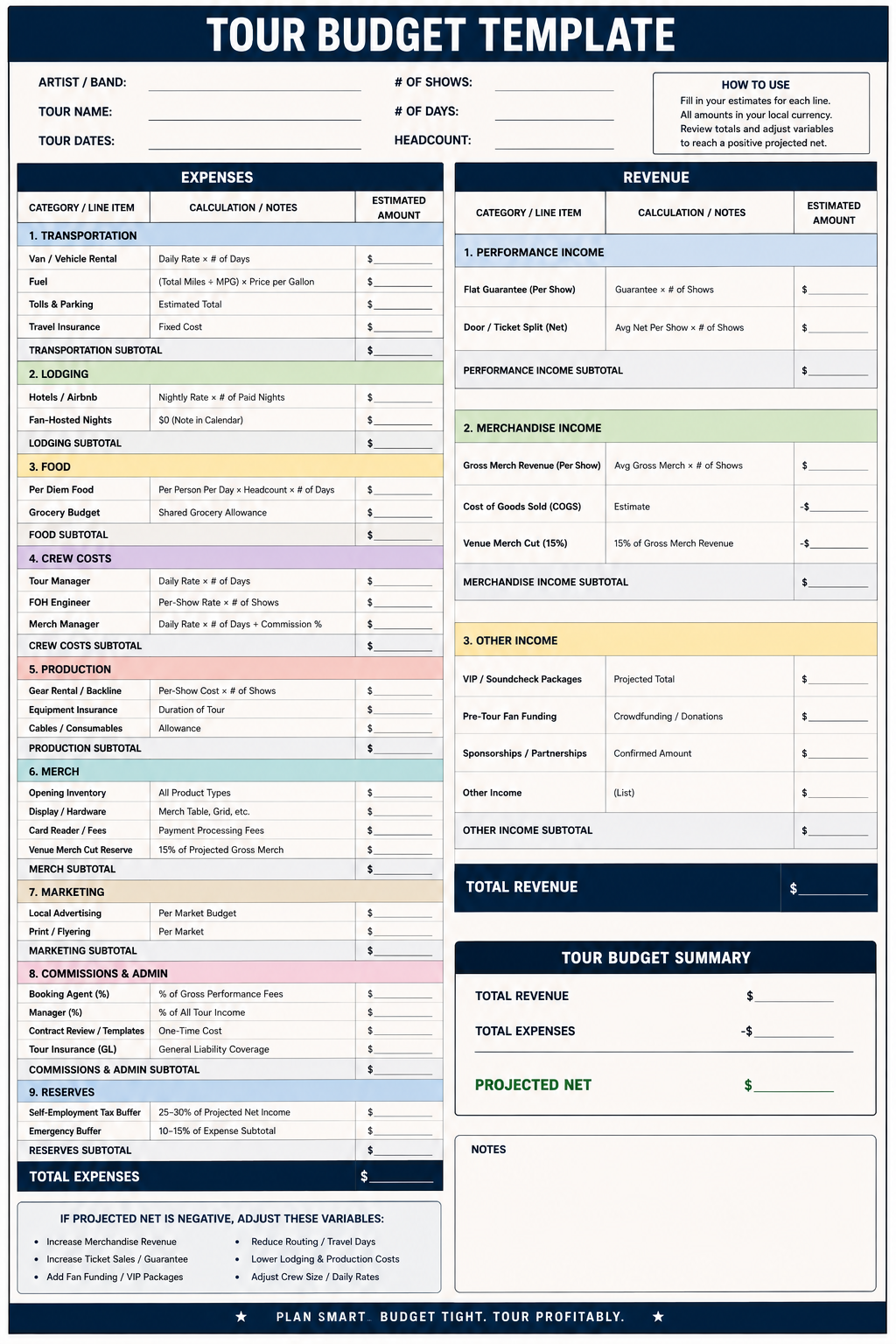
Merch budget lines should cover your opening inventory investment across all product types, display materials and hardware, card reader and payment processing fees, and a venue merch cut reserve calculated at 15% of your projected gross merch revenue. Marketing costs include local advertising budgets per market and any print or flyering expenses.
Commission and admin lines include your booking agent's percentage of gross performance fees, your manager's percentage of all tour income, contract review or template costs, and tour insurance for general liability coverage.
Finally, always include two reserve lines: a self-employment tax buffer at 25–30% of your projected net tour income, and an emergency buffer at 10–15% of your total expense subtotal.
On the revenue side, project each source separately: your flat guarantee per show times show count, your door or ticket split net of the venue's percentage, your projected gross merch revenue per show times show count, the deduction for cost of goods, the deduction for venue merch cut, any VIP or soundcheck package revenue, and any pre-tour fan funding received.
Subtract your total expenses from your total revenue to get your projected net. If the number is negative, identify which variables to adjust before you book a single date.
Costs First-Time Tourers Always Miss
A few line items fall out of every first-time budget and appear without warning on the road.
Self-employment tax on tour income is the most common and most expensive surprise. Guarantee and door income is self-employment income in the US. After federal income tax, self-employment tax adds 15.3% on top. Not reserving for this means the tax bill arrives months after the tour is finished and you've already spent the income.
Venue merch cuts are standard at 10–20% of gross merch sales. Negotiate this in advance. Some venues waive it entirely for artists who ask directly. Not accounting for it makes your merch revenue projection structurally wrong.
Build a kill fee clause into every performance contract — typically 50% of the guarantee if the venue cancels within 48–72 hours. Without it, a last-minute venue cancellation costs you a date, a night of lodging, fuel to get there, and zero compensation. To understand more about how performance contracts work from a business perspective, our overview of music publishing vs. record label rights covers the broader contract landscape artists navigate.
Cash flow timing catches many first-time tourers off guard. Expenses hit from day one. Final settlement on some shows may not arrive for 5–10 business days post-performance. Touring on a $1,500 float while waiting for settlements creates real on-road financial stress. Have more available than you think you need.
Phase 3 — On-Road Tracking and Post-Tour Reconciliation
Budgeting before the tour is step one. Tracking against that budget in real time is what separates tours that break even from tours that surprise you with a loss after the fact.
Every day on the road, someone needs to log actual spending against each line item. A shared document that any band member can update from their phone closes this loop without requiring a dedicated accountant. Save every receipt. Log every gas purchase. Record every merch settlement the night it happens.
The post-tour reconciliation review — comparing every actual cost against every projected figure — tells you which markets performed, which expenses ran over, and what needs to change on the next run. It takes two hours after you get home. Artists who skip it repeat the same expensive mistakes on every subsequent tour.
Conclusion
A well-built tour budget template does not just tell you what a tour will cost. It tells you whether the tour makes sense to run in the first place — and if it doesn't, exactly which variables to change until it does. Route more efficiently. Negotiate a higher guarantee in your stronger markets. Add one VIP night per city. The math reveals the levers before you're two hundred miles from home with no room to adjust.
For independent artists who are also beginning to work with booking agents or management, keeping tour financials organized inside a dedicated system — rather than across disconnected spreadsheets — is where operational discipline pays off at scale.
YourTempo is built for exactly this: music industry professionals managing tour finances, artist rosters, booking contracts, and payment tracking in a centralized platform designed for how the live music business actually works.
The math is not the hard part. Building the discipline to do it before you book the first show is.