July 17, 2026 |
Press, Booking Agency Pro
Key Takeaways
- An EPK works only when it's built around what a booker needs to say, yes, not everything an artist wants to say about themselves.
- Bio, photos, music, video, press proof, and contact details form the non-negotiable core of every kit.
- A one-page format that loads fast on mobile outperforms a long, scrollable "about me" page every time.
- Keeping an EPK current matters more than making it look fancy — outdated tour dates or stats quietly kill bookings.
- Agencies managing multiple artists need a system, not a shared folder, to keep every kit accurate and on-brand.
Booking agents and festival programmers get flooded with submissions every week. The artists who actually land a callback usually have one thing in common: an electronic press kit that makes saying yes easy.
An electronic press kit, or EPK, is the single asset that turns a cold pitch into a real conversation. Done right, it answers every question a talent buyer has before they even ask it.
Whether you're piecing together your first EPK for music artist submissions or refreshing one for a touring act, the fundamentals barely change. What shifts is who's reading it — a venue talent buyer, a blog editor, and a sync licensor all skim for different proof points within the same few seconds.
This guide breaks down exactly what belongs in an EPK, how to structure it, and — because most guides stop at the artist level — how agencies and managers keep dozens of these kits accurate at once.
What Is an Electronic Press Kit, and Why It Decides Whether You Get Booked
An electronic press kit for musicians is a digital summary of everything a promoter, venue, or press outlet needs to evaluate an artist. It replaces the old paper packet of photos, bios, and demo CDs.
Think of it as a resume built for the music industry. A talent buyer scanning fifty submissions in an afternoon opens the one that's easiest to assess in under a minute.
That's the entire function of a band electronic press kit — reduce friction. The artist with the clearest, fastest-loading kit usually gets picked over the one with better music but a messier pitch.
The Core Elements of an EPK That Gets a Response
Every strong artist electronic press kit shares the same backbone. Skip a piece here and you're handing a booker a reason to move on to the next submission instead.
Artist Bio That Does the Selling
Write two versions: a 50-75 word bio for quick scans and a 200-word version for anyone who wants more context. Use third person only — it reads as more credible to press and promoters.
Lead with your strongest, most recent accomplishment. A booker deciding in seconds needs the headline first, not the full origin story.
Photos and Visual Assets
Include both horizontal and vertical, high-resolution shots. Venues use these for flyers and social posts, so give them something they can drop straight into a template.
One live shot and one posed promotional photo covers most requests. Skip anything blurry, dated, or off-brand — a mismatched photo can undercut a strong bio instantly.
Music Selection
Choose three to five tracks, led with your strongest song rather than your newest one. Embed a player if your hosting option allows it, since most bookers won't click away to another tab.
Match the selection to the pitch. A festival submission wants high-energy tracks up front; a sync or licensing pitch might favor your most cinematic work instead.
Video and Live Footage
A short clip of a live set tells a booker more about stage presence than any paragraph of bio copy ever could. If professional footage doesn't exist yet, a clean phone recording still beats nothing.
Music videos and lyric videos have their place too, but live footage answers the question a talent buyer actually cares about: can this artist hold a room full of people?
Press Quotes and Achievements
Pull two or three real quotes, credited to their source, instead of a wall of vague praise. Pair them with concrete numbers — stream counts, show counts, notable stages played.
Specifics build trust faster than adjectives do. "Played 40 shows in 2025, including two festival mainstage slots" does more work than "an incredible live act."
Contact and Booking Details
This sounds obvious, but it's the single most common miss. Put booking, management, and press contacts in one visible spot, never buried at the bottom of a PDF nobody scrolls to.
Tour Dates and Availability
If you're actively touring, a short list of upcoming dates helps a promoter picture you on their calendar rather than in the abstract. It also signals that someone else already trusts you with a stage.
No dates booked yet? Skip the section entirely rather than listing vague "coming soon" placeholders that read as thin.
A Simple EPK Template Musician and Bands Can Copy Today
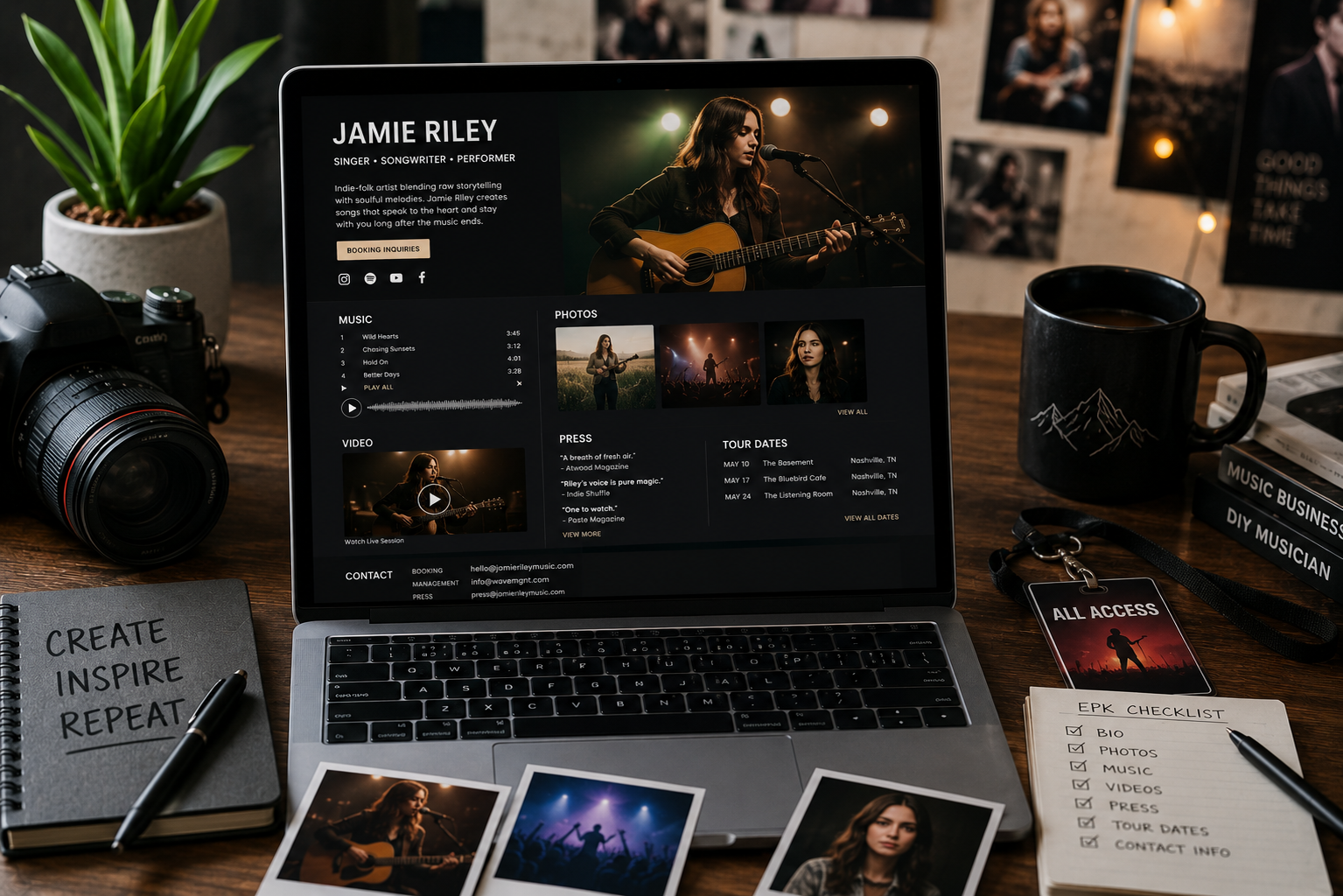
If you're figuring out how to make an EPK without overthinking the design, use this order: name and one-line hook, short bio, embedded music, photos, live video, press quotes and stats, tour dates, contact info.
That sequence mirrors how a booker actually reads a pitch — hook first, proof last. For an
independent artist without a publicist or design budget, this structure alone is often the difference between a kit that gets read and one that gets skimmed past.
Keep the whole thing to one scrollable page wherever possible. A press kit that requires downloading several separate attachments rarely gets opened past the first one.
Where to Host Your Electronic Press Kit
Three formats work well: a dedicated page on your own website, a link-based page through a builder tool, or a PDF for direct email attachments. Each has its place depending on who's asking.
A website page gives you full control over design and keeps traffic on your own domain. A PDF is mainly useful as a backup for submission forms that specifically require a file rather than a link.
More agencies are shifting this hosting decision onto cloud-based platforms rather than local folders, since a link that stays current beats a file that quietly goes stale on someone's desktop.
Whichever you choose, test every single link before sending it out. A broken streaming link or a dead contact email is often the real reason a promising pitch quietly goes nowhere.
Tailoring Your EPK for Different Gatekeepers
The same kit shouldn't necessarily go out unchanged every time. A venue talent buyer wants proof you can draw a crowd — past attendance, local following, tour history.
A press or blog contact cares more about story and sound than ticket sales, so leading with a compelling bio angle serves that pitch better. A sync or licensing contact working in
music publishing wants clean, instrumental-friendly cuts and clear usage rights up front, not a full band bio.
None of this means building three separate kits from scratch. Keep one core asset library, then reorder or swap the opening section depending on who's about to open the link.
The Business Side: Keeping EPKs Current Across an Entire Roster
Here's where most advice on this topic stops short. A solo artist can keep one kit updated by hand. An agency or management company juggling a full roster usually can't do the same thing at scale.
Every artist's EPK needs to reflect their current tour dates, latest release, and freshest stats — and those details change constantly across dozens of clients at once. Manually chasing updates across scattered folders and old email threads is exactly where things quietly fall apart.
This is the kind of operational gap that dedicated music business management software is built to close, syncing artist bios, tour calendars, and asset libraries so nobody's booking materials go stale between offers.
Version control matters just as much as updates. When every team member pulls from the same source instead of an old email attachment, nobody accidentally sends a promoter last year's stats.
There's a revenue angle here too. A publishing contact pitching sync opportunities cares about entirely different details than a booking agent does, even though both are working from the same underlying artist profile.
Common Mistakes That Get an EPK Deleted
Outdated information is the biggest one. A bio mentioning an "upcoming release" that actually came out eight months ago signals neglect immediately.
Overloading the kit is a close second. Fifteen tracks and twenty photos ask a busy booker to do curation work that was supposed to be yours.
Buried or missing contact details finish the list. If a promoter has to hunt for how to reach you, they'll move on to the next artist who made it easier.
Sending a kit that isn't tailored to the opportunity rounds it out. A jazz club and a festival mainstage want different proof points, and a generic one-size-fits-all pitch reads as lazy to anyone reviewing dozens a week.
How and When to Send Your EPK
Send your EPK whenever you're pitching a festival, venue, playlist curator, or press outlet — and keep the link handy in your email signature and social bios year-round.
Personalize the note around it every time. A single line explaining why this specific booker or outlet is a genuine fit outperforms a generic mass pitch by a wide margin.
Teams handling several submissions at once often track this outreach through the same
music booking software they already use for offers and routing, so a promising reply never gets lost in a separate inbox.
Follow up once, politely, after seven to ten days if you haven't heard anything back. After that, move on and keep pitching the next opportunity.
Conclusion
A strong electronic press kit isn't about looking flashy — it's about removing every reason a booker might have to say no. Get the essentials right, keep them current, and the pitch does the rest of the work.
The artists who book consistently treat their EPK as a living asset, not a one-time project. A tight bio, current photos, a handful of strong tracks, real proof of what you've already done, and contact details that are easy to find will outperform a longer, more elaborate kit almost every time.
Tailor it to whoever's opening the link, keep it current after every release or milestone, and resist the urge to add more than a busy booker actually needs to say yes.
For teams managing more than one artist, the real challenge shifts from building a great kit once to keeping many of them accurate at scale — which is exactly the kind of workflow platforms like YourTempo are built to support.
Frequently Asked Questions
Q.1 What should an EPK include at minimum?
A: A short bio, two or three strong photos, three songs, one live video clip, and clear booking contact details cover the essentials any booker needs for a first-pass pitch.
Q.2 How long should an electronic press kit be?
A: Aim for one scrollable page rather than a multi-page document. If a booker needs more than a minute to find what they're looking for, the kit has already gotten too long.
Q.3 Is a PDF or website EPK better for musicians?
A: A website page offers more control and far easier updates over time than a static file. Keep a PDF version handy only for forms that specifically require a file upload.
Q.4 How often should I update my EPK for a musician?
A: Review it at least quarterly, and update it immediately after any new release, major milestone, tour announcement, or notable show worth mentioning to bookers.
Q.5 Do new artists need an EPK before they have press coverage?
A: Yes. Start with a bio, a few photos, and your best tracks — the press quotes and achievements sections can grow naturally as your career and catalog develop.