
Key Takeaways
- A music publisher controls the composition copyright (melody, lyrics); a record label controls the master recording. These are two separate legal assets.
- Royalties from radio, streaming, and sync flow through different channels depending on which right is being used — and failing to register and track both means leaving income unclaimed.
- A sync license requires sign-off from both the publisher and the label, making clear deal documentation essential for any placement opportunity.
- Independent artists increasingly retain their master rights through self-distribution while using publishing administration services to collect global royalties without surrendering copyright control.
- As music businesses grow, managing publisher and label relationships at scale requires dedicated software, standardized workflows, and centralized contract and catalog oversight.
If you've spent any time navigating the music industry, you've heard both terms used—sometimes interchangeably, almost always incorrectly. A music publisher and a record label are not two versions of the same thing. They protect different assets, collect different money, and serve different purposes in an artist's career. Getting them confused can cost songwriters thousands of dollars in uncollected royalties.
This guide breaks down exactly what each entity does, where their responsibilities diverge, and what every music professional should understand before signing anything.
The Two Copyrights Inside Every Song
Here is the clearest way to frame it: every commercially released song contains two separate copyrights. The first is the musical composition — the underlying melody, chord structure, and lyrics. The second is the master recording — the specific recorded version of that composition. A music publisher controls the composition. A record label controls the master. These rights are legally distinct, commercially separate, and collect royalties through entirely different channels.
That single distinction is the foundation of how music publishing works — and why music businesses that fail to track both sides often leave significant revenue on the table.
What a Record Label Actually Does
Masters, Marketing, and Money
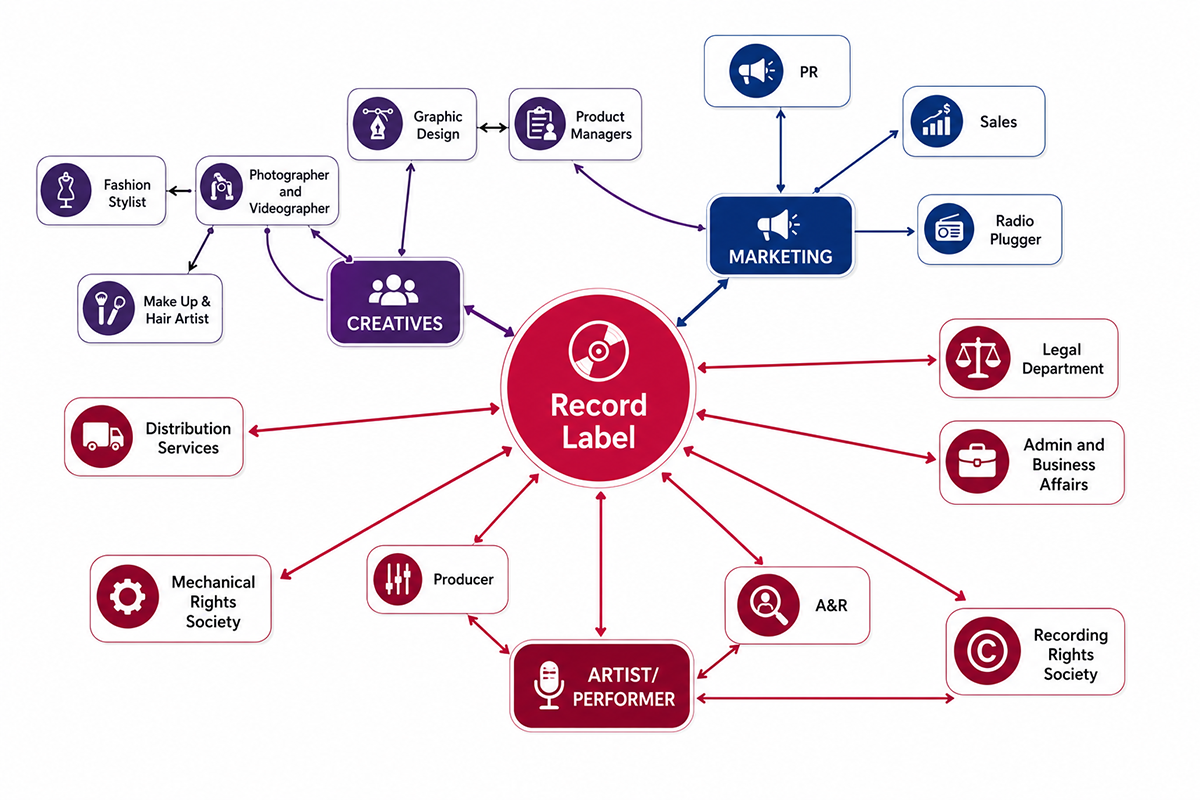
A record label's core function is to invest in the recording of an artist's music and then monetize that investment. When a label signs an artist, it typically funds the production of the master recording — studio time, session musicians, mixing, mastering — and then owns or co-owns the resulting master file.
From there, the label handles distribution (getting the record onto streaming platforms, physical retail, and download stores), marketing campaigns, playlist pitching, radio promotion, and in some cases, music video production. The label recoups these costs before the artist starts seeing significant royalties from recording revenue.
It is worth noting that the advance a label pays is not a gift — it is a loan against future royalties. Until it is recouped, the label keeps most of the recording revenue. Once recouped, the split moves to whatever percentage the recording contract specifies.
Record labels generate income primarily through master royalties: the revenue share paid by streaming platforms, digital downloads, physical sales, and synchronization deals for the recorded version of the song.
What a Music Publisher Actually Does
How Does Music Publishing Work?
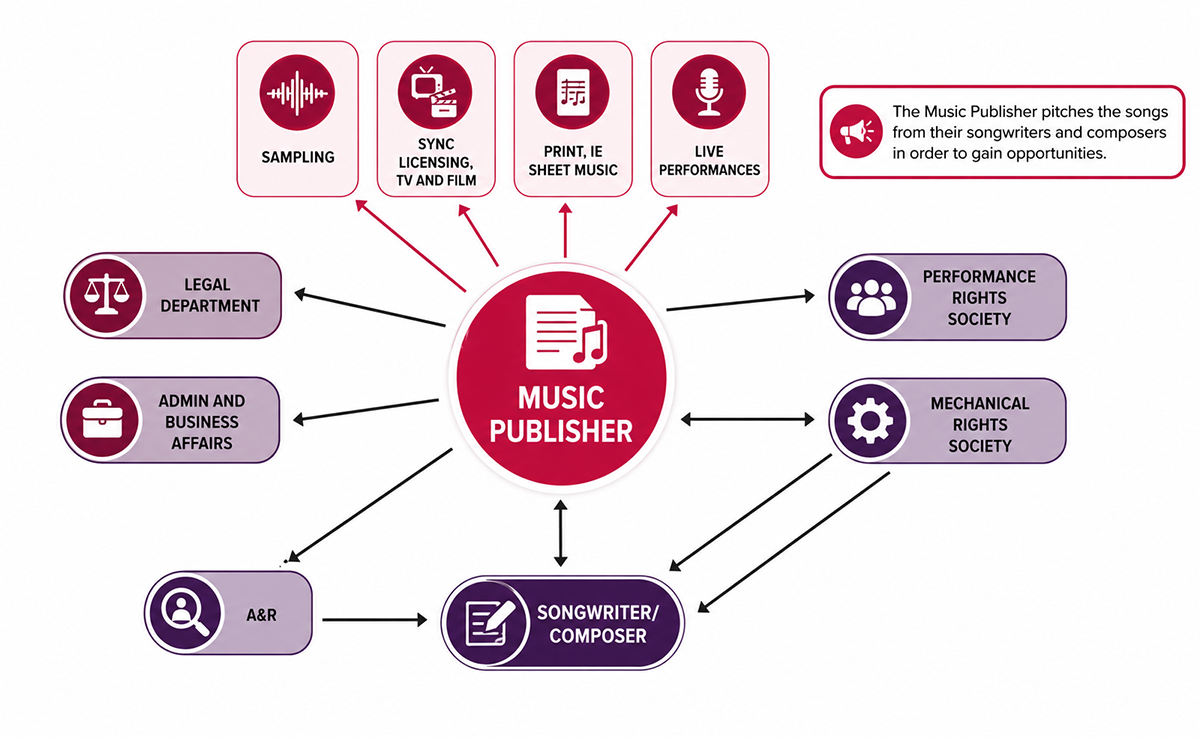
A music publisher manages the composition copyright — not the recording. Their job is to make sure that every time a song's melody, lyrics, or structure is used anywhere in the world, the songwriter gets paid. That includes radio play, live performances, streaming, downloads, advertising placements, and film or television sync licenses.
To do this, a publisher registers compositions with performing rights organizations (PROs) such as ASCAP, BMI, or SESAC in the United States, or PRS, SOCAN, and APRA in other territories. The PRO then monitors usage and distributes performance royalties back to both the publisher and the writer.
Publishers also pitch compositions for sync opportunities — placing songs in film, TV, commercials, and video games — which can represent some of the most significant income in a songwriter's catalog. A well-managed sync catalog managed through proper music catalog management practices can generate revenue for decades, long after an album cycle ends.
Beyond royalty collection, publishers may provide creative services: co-writing sessions, song pitching to other recording artists, and copyright protection in the event of infringement.
How Royalties Flow Differently Between the Two
| Category | Music Publisher | Record Label |
|---|---|---|
| Primary Focus | Songwriting and compositions | Sound recordings and masters |
| Rights Managed | Composition rights (lyrics and melody) | Master recording rights |
| Owns / Controls | The underlying song | The recorded version of the song |
| Works With | Songwriters, composers, lyricists | Recording artists, bands, producers |
| Main Responsibilities | Copyright administration, licensing, royalty collection, and song promotion | Recording, production, marketing, distribution, and artist development |
| Revenue Sources | Performance, mechanical, sync, and print royalties | Streaming revenue, sales, master-use licenses, and neighboring rights |
| Royalties Generated When | A song is performed, streamed, covered, broadcast, or licensed | A recording is streamed, sold, downloaded, or licensed |
| Collected By | PROs, mechanical societies, and publishers | DSPs, distributors, and record labels |
| Payment Flow | User → PRO/Agency → Publisher → Songwriter | User → Streaming Platform/Distributor → Label → Artist |
| Copyright Type | Composition copyright | Sound recording (master) copyright |
| Example Scenario | Another artist records a cover version of your song | Your original recording is streamed on Spotify |
| Goal | Maximize the value of the song | Maximize the value of the recording |
| Simple Explanation | Publisher = Song | Label = Recording |
| Master Royalties (Streaming / Sales) | Not controlled by publisher | Controlled by the label; paid to artist after recoupment |
| Performance Royalties (Radio / Live) | Controlled through PROs and publishers; paid to songwriters | Generally not involved |
| Mechanical Royalties (Streams / Downloads) | Controlled through publishers or mechanical societies; paid to songwriters | Not involved |
| Sync Royalties (Film / TV / Ads) | Controls composition rights; receives publisher's share | Controls master rights; receives master owner's share |
| Where Revenue Ultimately Goes | Publisher → Songwriter | Label → Artist (after recoupment) |
At a Glance
| Royalty Type | Who Controls It | Where It Goes |
|---|---|---|
| Master (Streaming / Sales) | Record Label | Label → Artist (after recoupment) |
| Performance (Radio / Live) | PRO → Publisher | Publisher → Songwriter |
| Mechanical (Streams / Downloads) | Publisher / Mechanical Society | Publisher → Songwriter |
| Sync (Film / TV / Ads) | Both Record Label & Publisher | Split between Master Owner & Publisher |
Sync licensing is the one area where both entities must agree. A music supervisor licensing a song for a commercial needs permission from the master owner (usually the label) and the composition owner (usually the publisher). If either party declines, the license cannot proceed.
Do You Need Both — or Neither?
The answer depends on what role you play in the music ecosystem.
If you are a recording artist who does not write your own songs, you likely need a record deal but may not need a publishing agreement. If you are a songwriter who writes for other artists but does not record commercially, you need a publisher but have no use for a record label in the traditional sense.
Many working professionals — particularly an independent artist navigating the modern streaming economy — retain their master rights through self-distribution and seek publishing administration (rather than a full publishing deal) to collect royalties globally without surrendering copyright ownership. Publishing administration gives you the collection infrastructure of a publisher without the long-term creative control clauses that traditional publishing deals often require.
And yes, many artists operate with both: a label controlling the master and a publisher managing the composition. These deals do not conflict — they run in parallel.
Managing Publisher and Label Relationships at Scale
Understanding the conceptual difference between a publisher and a label is one thing. Managing both relationships across a roster of artists — with different deal structures, royalty splits, contract terms, and reporting cycles — is an entirely different operational challenge.
This is where music operations often break down. Booking agencies and artist management firms that expand into publishing or label partnerships find that spreadsheets and email chains simply cannot keep up with the volume. Deadlines get missed. Royalties go untracked. Deal terms conflict.
Networking in music industry circles — conferences, publisher showcases, label summits — is how most of these relationships get started. But sustaining them requires infrastructure. That means standardized contract templates, royalty tracking workflows, and clear reporting that both sides of a deal can reference without confusion.
Music Business management software has become an operational baseline for any serious music business handling multiple artist relationships simultaneously. The ability to track composition registrations, monitor deal status across labels and publishers, and manage financial reporting in a single system is no longer a luxury — it is how competitive music businesses stay organized and minimize revenue leakage.
Cloud-based platforms have made this level of operational oversight accessible even to small and mid-size music companies that previously relied on disconnected tools. The result is faster royalty reconciliation, fewer contract disputes, and cleaner communication between managers, artists, and business partners.
Conclusion
The line between a music publisher and a record label is sharper than most people realize — and understanding it has direct financial consequences. Every song contains two separate copyrights, and each one generates income through different systems, different organizations, and different contractual relationships.
For music businesses managing multiple artists, the complexity scales quickly. Tracking compositions across publisher agreements, monitoring master rights across label deals, and reconciling royalty statements across territories demands more than memory and a spreadsheet. Platforms like YourTempo are built specifically for music industry professionals who need centralized tools to manage publishing assets, label relationships, artist contracts, and financial workflows — all without the operational friction that comes from managing it piecemeal.
Knowing the difference between a publisher and a label is where the conversation starts. Having the right systems in place to manage both is where the real business begins.
Frequently Asked Questions
Q.1 Can a record label also act as a music publisher?
A: Yes. Many major labels operate in-house publishing divisions. However, the composition and recording rights are still treated as separate assets, even within the same company.
Q.2 What is the difference between a publishing deal and a publishing administration deal?
A: A full publishing deal typically involves an advance and partial or full copyright transfer. A publishing administration deal collects royalties on your behalf for a commission — without taking ownership of your compositions.
Q.3 Who collects mechanical royalties on streaming platforms?
A: Streaming services pay mechanical royalties directly to mechanical rights organizations, which then distribute them to publishers and songwriters based on registered composition data. This is why proper catalog registration is critical.
Q.4 Do I need a PRO if I have a music publisher?
A: Yes. Songwriters should be registered with a PRO directly, independent of their publisher relationship. The PRO pays the writer's share of performance royalties directly to the writer — the publisher does not pass that portion through.
Q.5 Can I have both a record deal and a publishing deal at the same time?
A: Absolutely — and many working artists do. The two agreements cover different rights and do not conflict, provided the contracts are carefully reviewed to avoid overlap clauses.