Key Takeaways
- Spreadsheets lack real-time collaboration, leading to scheduling conflicts, double bookings, and missed revenue opportunities for booking agencies.
- Manual data entry for artist contracts, offer tracking, and show scheduling increases the risk of costly, relationship-damaging errors.
- Purpose-built booking technology provides centralized artist roster management, automated contract tracking, and accurate financial reporting.
- Cloud-based platforms allow agents, artists, and managers to access live booking data from any device, at any time.
- Music Booking management software helps agencies scale their operations without adding unnecessary administrative overhead.
Introduction
Running a music booking agency in today's entertainment industry demands speed, precision, and seamless coordination across artists, venues, buyers, and managers. Agents are simultaneously tracking multiple offers, managing complex tour routing, and negotiating contracts — all while maintaining the relationships that keep the roster growing.
For decades, spreadsheets have been the default solution for this complexity. They are familiar, low-cost, and quick to set up. But as artist rosters expand and booking workflows become more demanding, those familiar grid cells are quietly costing agencies time, money, and competitive edge.
Why Booking Agencies Still Reach for Spreadsheets
The appeal of spreadsheets is straightforward. They require no onboarding, no subscription, and no technical expertise. For an agency just starting out with a handful of artists, a well-organized spreadsheet can feel like more than enough.
But the pace of the music business is unforgiving. Once an agency begins managing multiple artist rosters, coordinating venue availability across dozens of dates, tracking offer statuses, and reconciling commissions, the limitations of manual tools become impossible to ignore. What begins as a simple solution quickly becomes an obstacle to growth.
The Real Cost of Managing Bookings with Spreadsheets
Scheduling Conflicts and Double Bookings
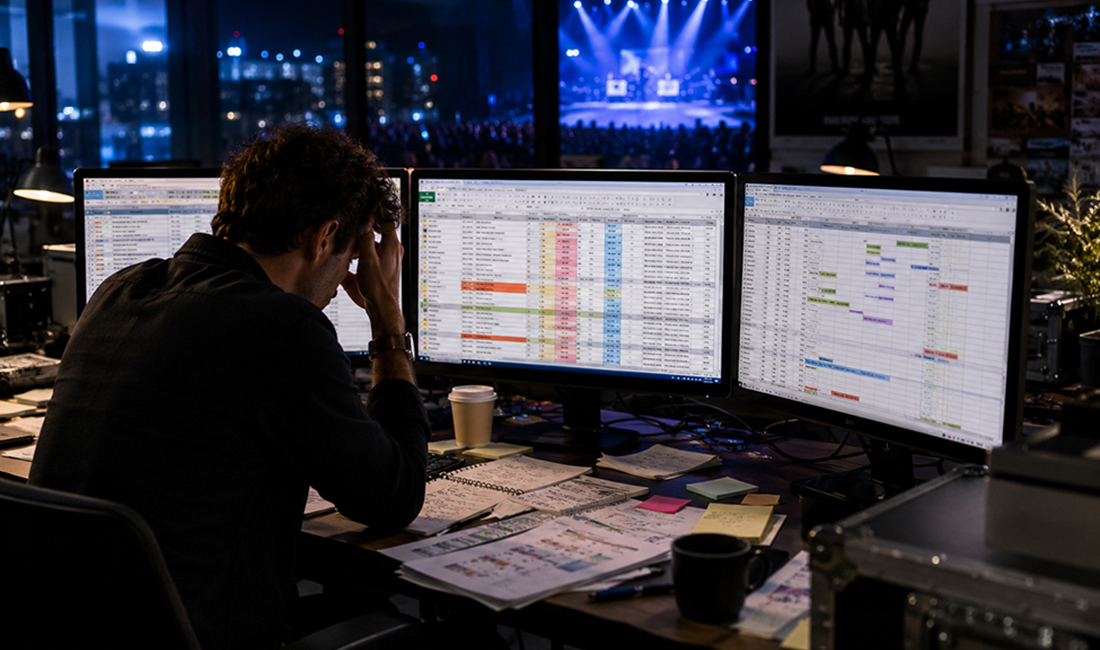
One of the most damaging consequences of spreadsheet-based booking is the risk of double-booking an artist. When multiple agents are editing shared files — or working from separate versions — conflicting entries are almost inevitable.
A missed hold, an outdated availability record, or an entry made in the wrong row can result in two confirmed shows on the same night. That kind of error strains relationships with promoters and venues, harms the agency's credibility, and can seriously damage an artist's touring reputation.
Contract Tracking Becomes Unreliable
Every confirmed booking involves multiple stages: the initial offer, follow-up negotiation, signed contracts, deposit collection, and post-show settlement. Managing all of these stages across spreadsheet rows — with no automated status tracking — is both time-consuming and error-prone.
Without a structured pipeline, agents have no clear view of where each deal actually stands. Offers go out and get forgotten. Deadlines for signed contracts slip by without reminders. Deposits go uncollected because there was no automated prompt to follow up, and the agency absorbs the loss.
Financial Reporting Drains Productive Hours
Calculating commissions, tracking walk amounts, reconciling deposits, and generating accurate revenue reports are all essential to running a profitable booking agency. In a spreadsheet environment, these tasks demand hours of manual work, cross-referencing, and formula maintenance every single reporting period.
One misplaced formula or an accidentally overwritten cell can distort an entire month of financial data. And when leadership needs an immediate snapshot of agency-wide earnings, generating that report from raw spreadsheet data is rarely quick — and rarely trustworthy without a manual audit.
Collaboration Breaks Down at Scale
As agencies grow, more people need structured access to booking data — agents, road managers, business managers, and the artists themselves. Spreadsheets were simply not designed for this kind of multi-user, role-based access.
Without controlled permissions, critical data is exposed to accidental edits or deletions. Sharing files over email creates version confusion that compounds over time. And when venue details, offer terms, or contact records are updated by one person, there is no guarantee the rest of the team is working from the same information.
What the Modern Booking Agency Actually Needs
Centralized Artist and Venue Management
A booking agency's entire operation is built on relationships — with artists, venues, and buyers. When those relationships are spread across disconnected spreadsheet files, context gets lost every time a deal progresses or a contact changes.
A centralized system ensures that when an agent pulls up a venue, all past offers, communication history, and deal records are immediately available. Every pitch, follow-up, and negotiation lives in one organized place, accessible to everyone who needs it — without the risk of working from outdated information.
Automated Offer and Contract Workflows
Modern booking operations require a clear, trackable pipeline from the first offer to the signed contract. When an independent artist is being pitched to multiple venues simultaneously, agents need instant visibility into every offer's current status without digging through rows of data.
Structured offer workflows eliminate manual follow-up reminders and status guesswork. Routing sheets, availability windows, and event itineraries can be produced quickly and distributed in the right format — not assembled one line at a time from a shared document.
Accurate Revenue and Commission Reporting
Booking agencies run on commissions. Having an always-current, accurate picture of earnings broken down by artist, by agent, and by time period is not optional — it is fundamental to making smart business decisions.
Purpose-built reporting gives agency leadership direct access to financial insights without manual calculation. Upcoming deposits, post-show walk amounts, and commission summaries are visible at a glance, allowing teams to focus on building their roster instead of reconciling data.
The Shift Away from Spreadsheets Is Already Happening
The most forward-thinking booking agencies are recognizing that the tools they use directly shape their ability to scale. Cloud-based platforms give entire teams — from office-based agents to managers on the road — live access to the same booking data from any device, at any time.
Music Booking management software is not simply about replacing spreadsheets. It is about building a structured, repeatable workflow that supports every stage of the booking process, from initial pitch through final settlement, without relying on manual processes that create errors and inefficiencies.
Agencies that invest in the right technology consistently spend less time on administrative tasks and more time doing the work that actually grows their business: cultivating artist relationships, securing better venue deals, and building the kind of operational reputation that attracts top talent.
Conclusion
Spreadsheets served their purpose when music booking was simpler. But modern agencies are managing more artists, more venues, and more financial complexity than any general-purpose tool was built to handle. The manual processes that once felt manageable have become a genuine barrier to growth, efficiency, and accuracy.
The agencies scaling fastest today are the ones that have replaced patchwork systems with structured, purpose-built workflows. They are issuing contracts, tracking offers, managing artist availability, and reporting on commissions without chasing outdated files or correcting formula errors after the fact.
If your agency is ready to leave spreadsheets behind, YourTempo offers a fully customizable booking platform Booking pro built specifically for the way music industry professionals work — covering everything from the first offer to post-show settlement, and giving every member of your team the visibility they need to perform at their best.
Frequently Asked Questions
Q.1 What are the biggest problems with using spreadsheets for music booking?
A: Spreadsheets are prone to errors, lack real-time collaboration, and have no structured tracking for offers, contracts, or financial reporting — all critical for booking agencies.
Q.2 How does specialized booking software prevent double bookings?
A: It uses live calendars with holds and blocks, giving all agents a shared, up-to-date view of artist availability so scheduling conflicts are flagged before they become confirmed errors.
Q.3 Can smaller booking agencies benefit from purpose-built booking tools?
A: Yes. Even agencies with modest rosters gain immediately from faster contract tracking, automated follow-ups, and accurate financial reporting that would otherwise require hours of manual work.
Q.4 How does booking software handle the full contract lifecycle?
A: It tracks each deal from offer to signed contract in a structured pipeline, with document management, status visibility, and reminders for outstanding tasks at every stage.
Q.5 What features should a booking agency prioritize when choosing new software?
A: Focus on calendar and availability management, offer and contract workflows, financial and commission reporting, CRM tools for venue and buyer relationships, and role-based access for artists and managers.